

When we weave double cloth on eight shafts, our choices start to multiply. As well as the basic choice we faced on four shafts, between the divided parallel and the straight threading approaches, we have a host of additional options both in terms of design elements and in shaft assignment. In this post I am going to focus on one of the most popular structures, double cloth blocks.
Moving from 4 to 8 shafts
Let’s call our four-shaft threading our basic double weave ‘unit’. For every additional four shafts, we can add a new independent threading unit of double weave, and start to develop the idea of working with blocks.
Do you want to understand double weave?
My online workshop has helped hundreds of weavers to master block double weave on an 8-shaft loom.
Two independent threading blocks
In weaving terms, when we talk about independence we are usually talking about shafts. When we manipulate a shaft by raising or lowering it, we raise or lower all the warp ends associated with that shaft. If we split those warp ends into two groups and assign each group to its own shaft, then we have the power to raise or lower one group of ends without affecting the other group.
Our two blocks will be independent in this sense. Each has its own set of four shafts, and no shafts are shared between the blocks. This means I can make different design choices for each block, e.g. seeing layer one on the face of the cloth in one block and layer two on the face of the cloth in the other block. This ability to juxtapose two completely different sets of warp and weft is one of the highlights of double cloth, allowing us to create the striking effects seen in classic ‘window panes’ combinations and many more.
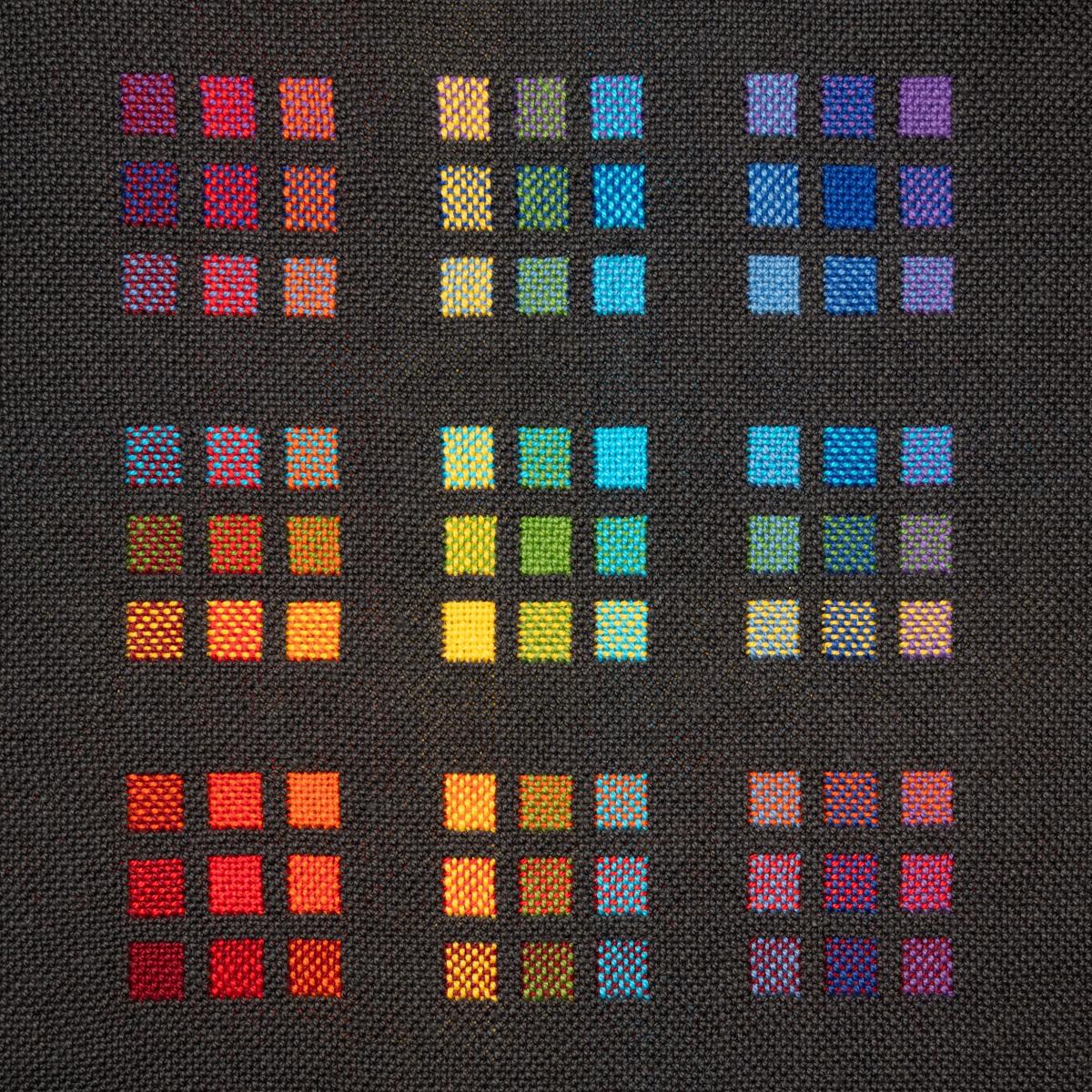
The basis for the double cloth classic ‘window panes’ is plain dark layer and a rainbow-striped layer threaded in two blocks on eight shafts
We can extend either of our four-shaft threading approaches to eight shafts by taking the threading unit on shafts 1 – 4 (let’s call this block A) and copying it directly onto shafts 5 – 8 (block B).
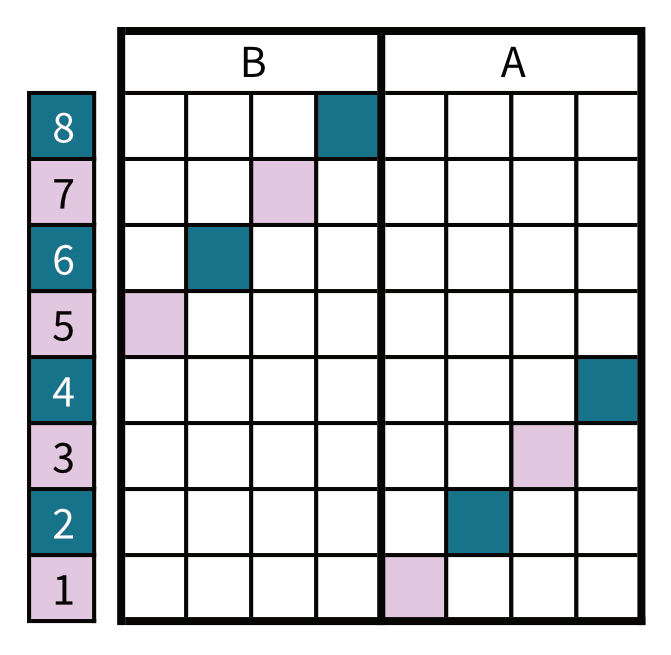
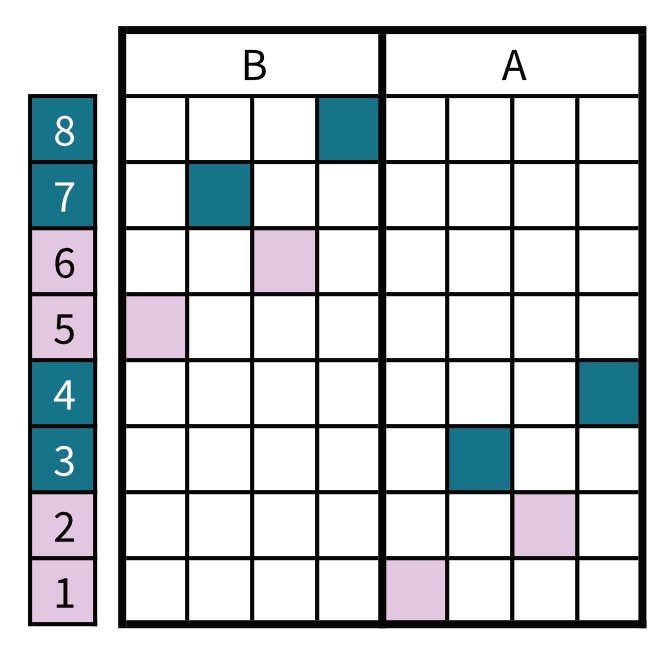
Each threading unit contains everything needed to make plain weave in that block, and it can be repeated as many times as we like before we move on to the other threading unit. This flexibility opens up a huge range of possible designs.
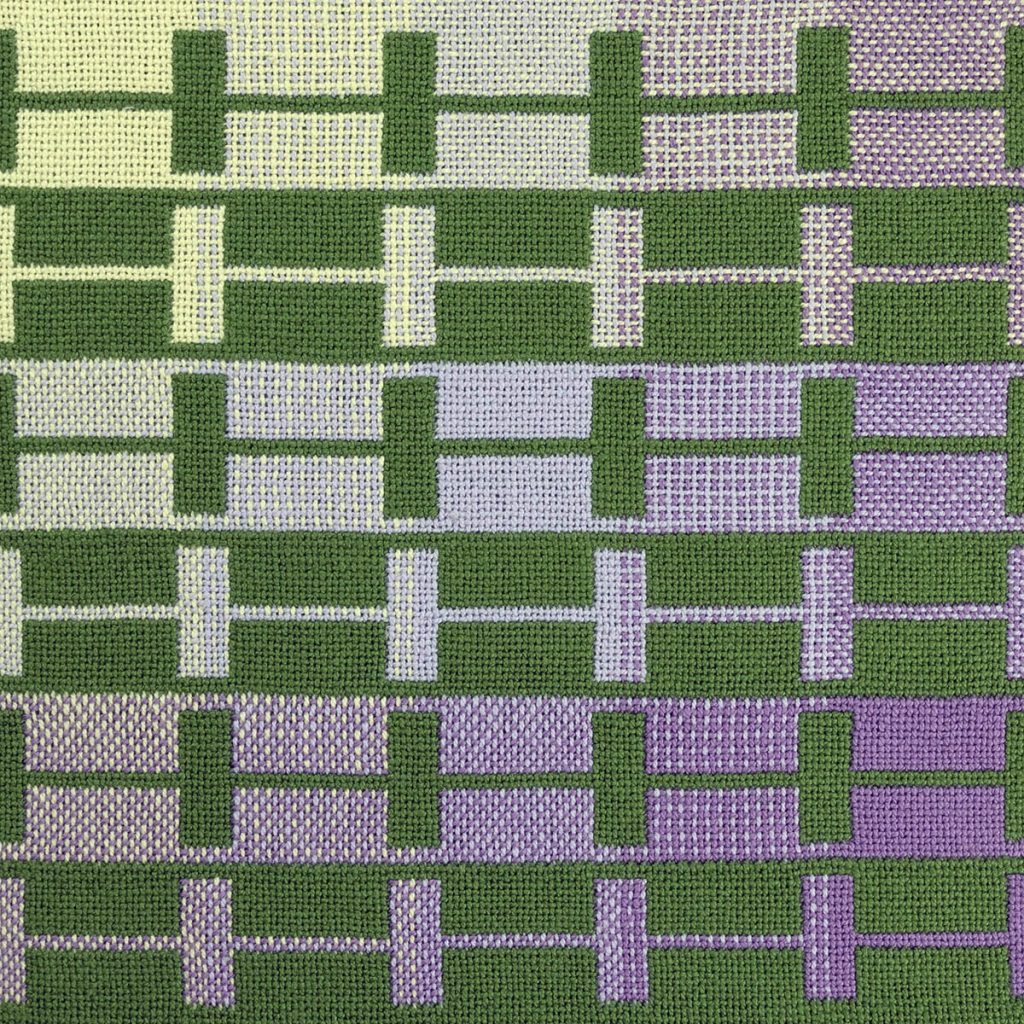
Alternating wide and narrow threading blocks 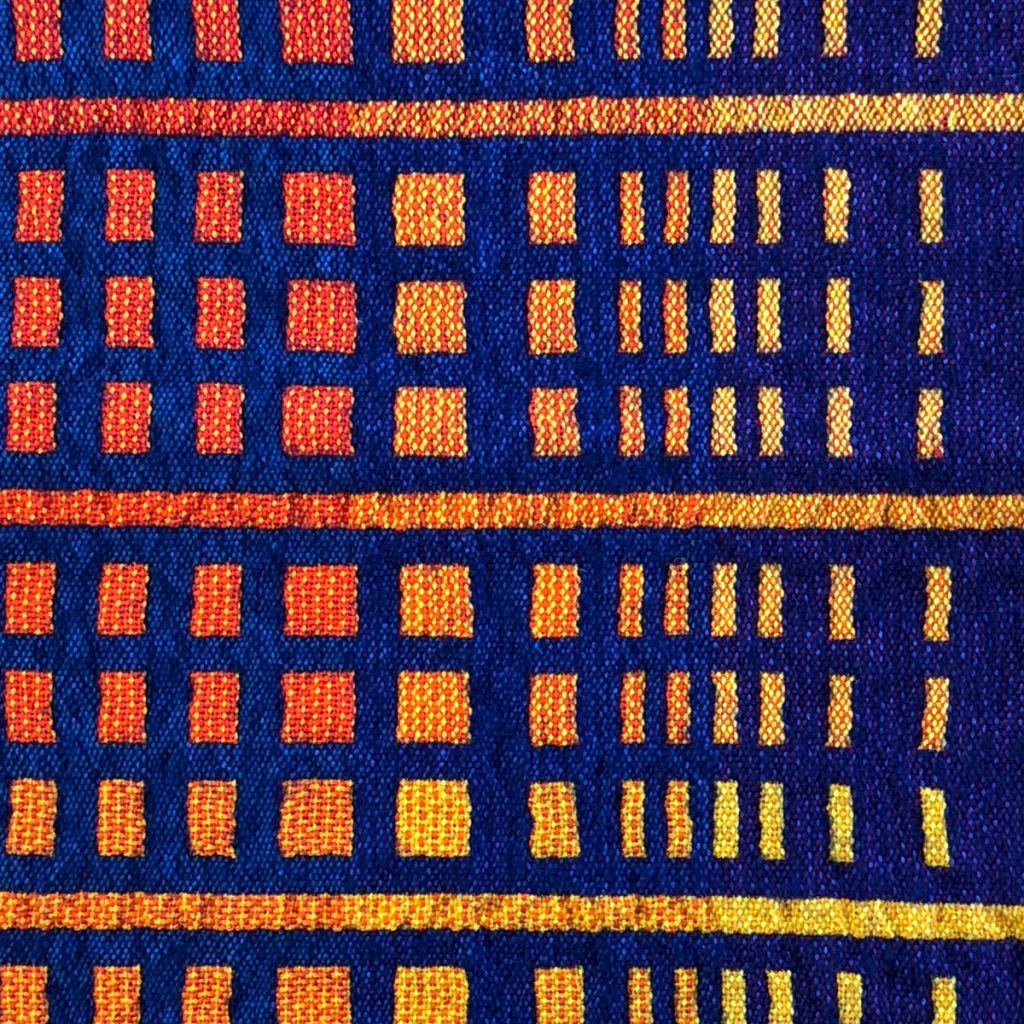
Threading blocks of all sorts of sizes 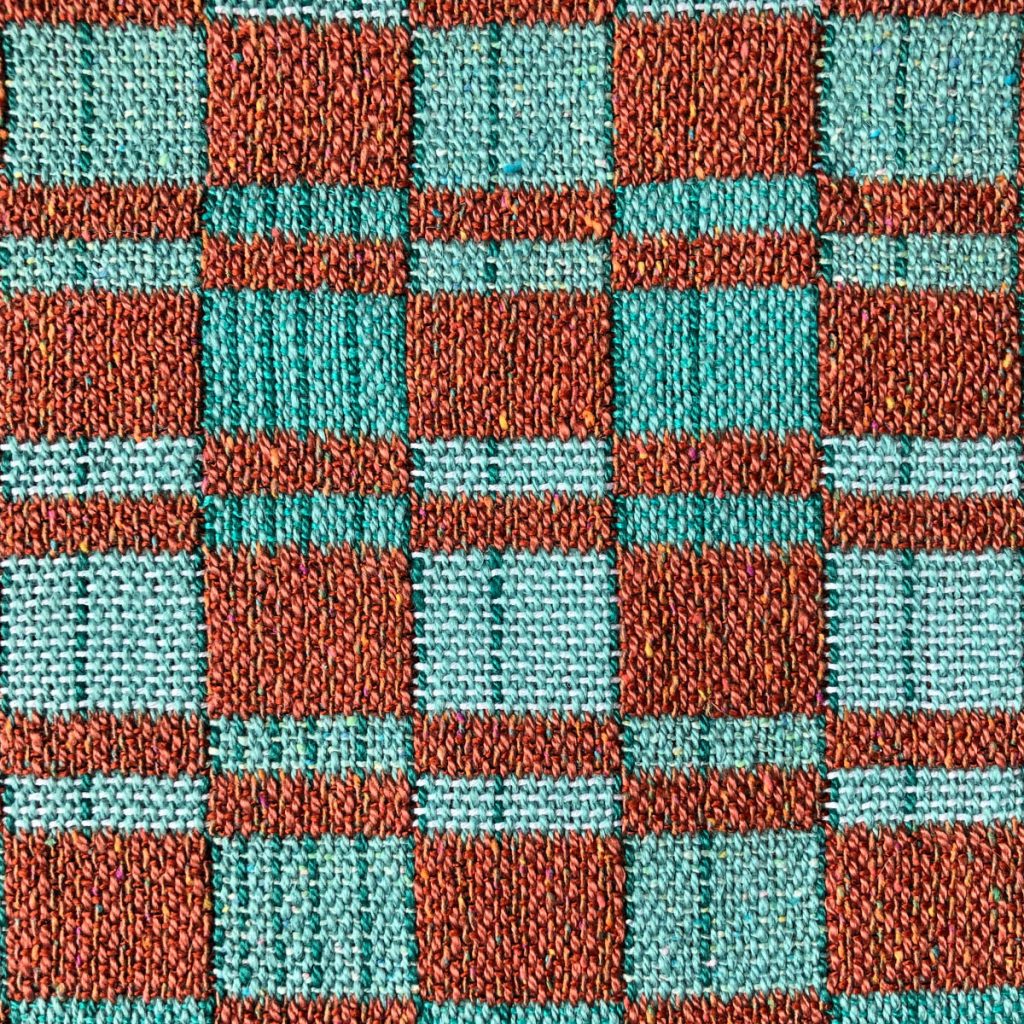
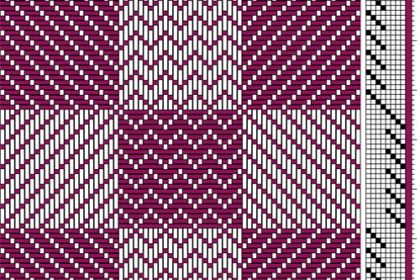
Threading blocks all the same size
Priority to blocks or to layers?
In the example threadings above, each of blocks A and B is assigned to a group of four adjacent shafts. A is threaded on shafts 1 – 4, B on shafts 5 – 8. When we use the straight threading, the result is essentially the same as it was on four shafts: layer one (my light pink layer) is assigned to the odd shafts and layer two (my teal layer) to the even shafts.
For the divided parallel threading, however, things look a little different on eight shafts. Layer one is now assigned to two pairs of shafts, 1 & 2 and 5 & 6, while layer two occupies the pairs 3 & 4 and 7 & 8. I would describe this threading as giving priority to the blocks, in that it is easier to quickly identify one block than it is to identify one layer. An alternative approach would be to give priority to the layers, so that each layer is assigned to a group of four adjacent shafts.
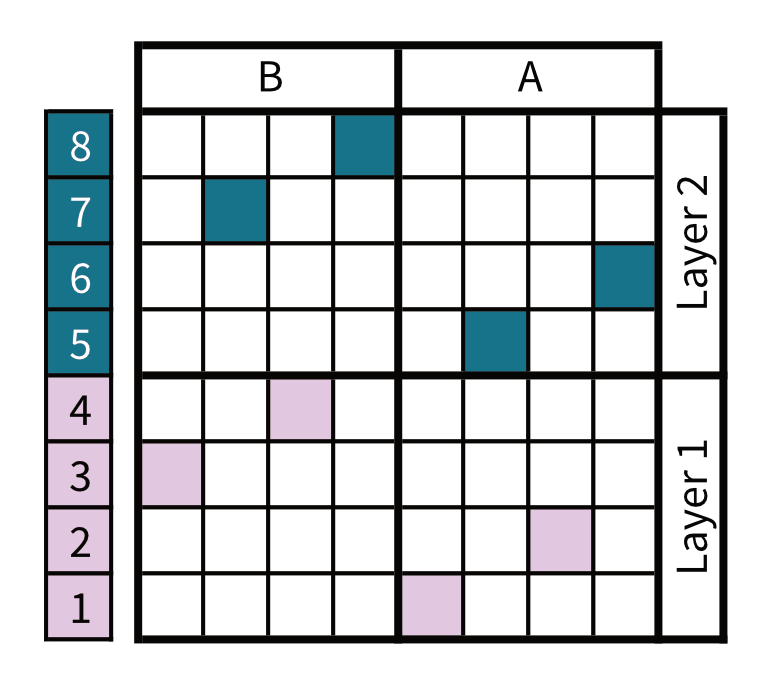
In this threading, layer one is assigned to the front shafts 1 – 4 and layer two to the back shafts 5 – 8, so in some respects it is more similar to our four-shaft threading. Cutting across the layers, each of blocks A and B is assigned to two pairs of shafts. A is threaded on shafts 1, 2, 5 & 6; B is threaded on shafts 3, 4, 7 & 8.
Choosing a threading for 8-shaft double cloth blocks
The important point is that all of these options are good options! You are free to choose one you get on with and stick to it, and it is probably a good idea to do this at first, while you get used to the processes and possibilities of double weave. Personally, I use all of them, and vary my usage mainly based on the kind of loom I am going to use and the kind of weaving I am going to do. I like doing this for a couple of reasons.
Firstly, it makes me focus on what I want to achieve at the loom, and how I want to work. If I am going to be using weaving software, then it makes sense to choose an approach which prioritises blocks, because that allows me to cut and paste units of threading and lifting very easily. I keep a few reference files where I store the basic components of a double cloth draft, and can pop them into the design as I need them. On the other hand, on my countermarche loom, I found it much easier to prioritise layers. To use a double weave skeleton tie-up on a countermarche loom, you need to tie up each layer separately but completely (as we saw on four shafts) and this is much simpler to manage if the shafts for each layer are in a contiguous block. And when I am sampling on a table loom, I find the same consideration applies in a different context: I can improvise very easily if I can quickly identify a layer.
To an extent, though, the ease with which one can work with a particular approach is governed by practice. Practice, practice, practice! And this is my second reason for mixing things up. By using different threading approaches I am keeping my weaving brain flexible, so that I can access different drafts expressed in a variety of ways by diverse weavers, and I value being able to do that. Essentially, this is about keeping our focus on the construction and not on the notation: the draft is important, but it is secondary to the goal, which is the cloth.
Coming up…
Over the next few posts, we’ll look at the liftplans and treadlings needed to weave some of these 8-shaft double weave block designs.
First posted on weavingspace.co.uk © Cally Booker





Thank you for this post. Just FYI on my iPad the photos are sitting on the words. It’s fine on my phone though.
Oh, that’s odd! Thanks for letting me know; I will see if I can tweak it.
I search “double width” but many “double weave” results come up. Are they the same thing?
Thanks
Lost-in-the-shaft
No, they aren’t. Double weave is a bigger topic – it includes double width, but many other techniques as well. I don’t do a lot of double width weaving so haven’t written about it here. However, a lot of people will say ‘double weave’ when they mean ‘double width’ so some resources you find will be applicable.
Double width is also a term used particularly in Harris Tweed weaving when the loom is twice the width of the traditional single width loom. (36”). No double weaving involved.
Yep, that’s a really good point.